
It begins with delight
A poem and a fable about creating good things

“The God of Genesis is unique in having, not a use, but instead a mysterious benign intention for humans.” —Marilynne Robinson
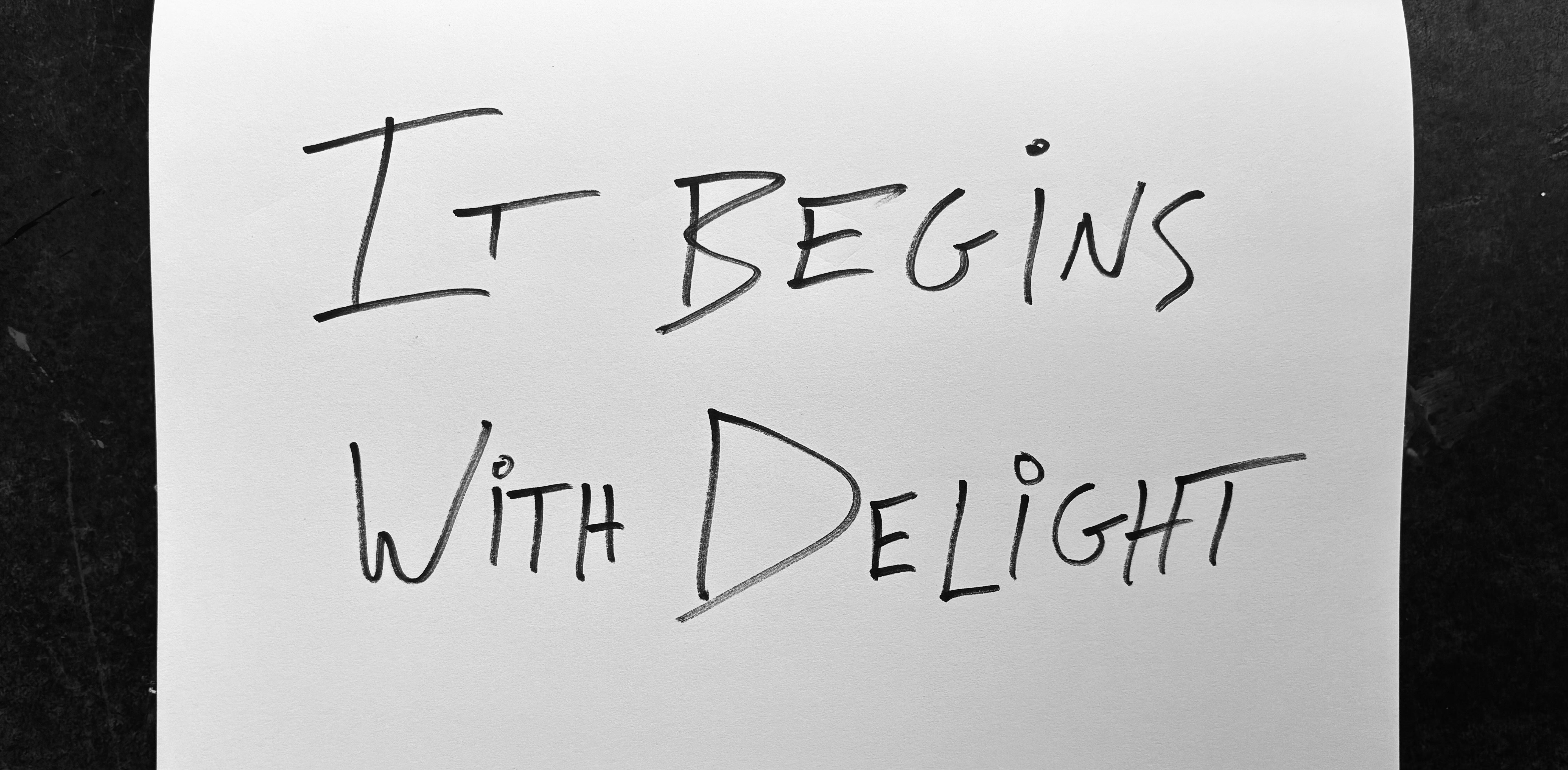
This week I gave a sermon about the stories of creation that are at the very beginning of the book of Genesis in the bible. Before giving the talk I reflected: What do I want to say about creation? What do I see in these stories? What do I hear?
This is what surfaced: That delight is at the heart of all creation.
I know what comes after these first couple of stories. I know that we’ll get to the death and the shame, the struggle and the judgement, the disappointment, the violence and mistreatment of each other and the earth.
But in the beginning a spirit of delight hovered over the soup of possibility and called good things into being.
Light and dark, good. The air we breath, the atmosphere we live in, good. The earth we move about on, good. The oceans we swim in, good. Seeds and fruit, sun and moon and stars, good good good. And swarms of fish and birds, good. Animals, along with us human animals, good. Very good.
It’s clear from the poem in Genesis chapter 1 that this is so. There is a tone of delight, of joy that imbues the very energy of creation.
And there might be something here for us. We are, after all—so the poem tells us—made up of the same creative stuff. We have the same nature and creative inclination as the Creator in the poem.
If we want to make something good in this world, perhaps we’d do well to look first and foremost to what it is that delights us.
We tend to get bogged down in what we should be doing. And, although there is a good and worthy place for obligation and duty, most of us don’t need to be coached toward obligation, we need a cultural corrective in order to keep from collapsing into an abyss of should’s.
Let that be delight.
This core message in the poem—that the Creator delights over creation, becomes even more pronounced when you understand the context of how and where this poem came to be.
The Hebrew bible is a story of a particular group of people trying to keep their identity and integrity intact in the midst of a world trying to break them apart.
Read that sentence again.
Does that resonate at all? Anything timeless and relatable to that?
The identity of the particular group of people was grounded in the conviction and ancestral memory that they were blessed by the central creative force of the universe, in order to be a blessing to the world.
The Hebrew bible began being compiled—that is, the stories and poems gathered together and written down—at a time when this group of people were in political exile. They had been forced from their homes by an empire called Babylon. In that context of displacement they brought these stories together, to remember who they were, in response to the challenges of their circumstances and the heavy hand of their oppressors.
Much of the bible is a remembering around identity. Which is a pretty good place to start when what you’re wanting to do is to make something good in the world.
Much of the bible is a response to empire theology. Which is pretty important, because empire
theology will have you running around in circles trying to: 1. Appease the oppressive powers of the day; or 2. Expend your energy trying to disprove it.
The best and most useful forms of wisdom literature don’t engage either of these two pulls, but instead finds a third way, putting forth an alternative, something more compelling and creative.
The theological profile of the Babylonian empire was more or less: The gods are indifferent, and we humans are a nuisance.
Here’s an alternative to that: God delights in all of creation like a mother hen gathering her brood, and we humans are called to participate in creating good things.
There is a second story that comes on the heals of the poem about the delighted Creator speaking delightful things into existence. That second story reads like a fable.
Before there ever was rain, God blew breath into a clod of dirt, and rendered a living soul.
Then God took up gardening. Especially fruit trees. It was more of an orchard really. God planted an orchard with trees that produced fruit—the original edible arrangement. And a couple of the trees that God planted had funny fruit. The fruit of one was life. The fruit of the other was knowledge.
And if you know anything about stories then you know this detail is not insignificant.
And if you’re one of those people who is inclined to turn the pages and look at the ending before you’ve even gotten through the beginning, then you will see that there are trees there too, just as there were at the beginning.
And if you know anything about stories then you’ll know that it’s significant that the rivers that God watered the orchards with have names. Pishon. Gihon. Hiddekel. The Euphrates. And that, even if you don’t recognize the names of these rivers, you can imagine someone somewhere once upon a time must have known the names. Just as you know the name of the street you grew up on, and the name of your grade school, and the name of the park where you played little league.
Which is all to say that God gets up to God’s business right in the midst of the most mundane matters and familiar places.
Which is to say that this story about the clod of dirt that became a living soul—that was told long ago by the exiled people who knew these rivers—this story about all of that is somehow also about you and me and the rivers of life that we know.
So. Then God deputized the living soul—whose substance came from the soil, so much so that we could also call this creature Living Soil, which was in fact his name.
Then God enticed Living Soil with unlimited good things and one, only one, prohibited thing.
(And if you know anything about stories—not to mention toddlers—then you know exactly where this one is heading. Or so you think.)
Then God made other animals to keep Living Soil company.
And everyone got a name.
This is where it all begins. A delightful universe. A delighted God. A diverse array of creatures with names, and an inclination to connect, to come to know one another’s names.
Wherever we go from here (or perhaps precisely because we know where we’re going from here—into the grit of the human experience on the other side of innocence) these beginning stories remind us to remember.
Remember that there is a divine heartbeat of delight at the center of everything.
Remember that we are called to re-center that delight one human heartbeat at a time.
In other words: What is the arc of the story that you want your life to tell?
Because you can live looking for ways to appease or disprove angry and vindictive gods? Alternately though, you can live looking for ways to join with a delighted and creative God in making good things?
Which story do you find more compelling?
—
PS - It doesn’t matter so much, by the way, whether or not you believe in God, per se. The question remains: Which story do you want your life to tell?
This is amazing. I love you!
The six D’s of God dumping love and breath into soil:
1. Decision—this flowed out of Divine intention.
2. Declaration—the world was formed through words, not violence between gods
3. Distance—there is none; God hovers over the waters.
4. Distinction—we are imagers of God, and all creation is filled with the Breath of Life
5. Direction—who can go to heaven to begin Christ down? Who can go to the realm of the dead to bring Christ up? God is a god of Kenosis. The Logos is close to your heart already. - Paul in Romans 10.
6. Delight—what you said. :)
I love this, Aram! Your re-telling of the old story gives me a fresh perspective. I had always seen the first two chapters of Genesis as just a lead-in to the “crucial” story of how humans “fell from grace”, and then there was a whole theology built around how we’re all born with a sin nature because of “the Fall”. I don’t buy that anymore, I don’t read the Bible as literal truth anymore, and I see the first 11 chapters of Genesis as myth, someone’s attempt to make sense of why things are as they are.
So I love the focus on delight! Thank you!